
Laura's Gap Semester
I had always dreamt of traveling and making a difference in my community. After completing high school, I looked for a gap year counselor who could guide me in choosing programs that would be best suited for me. Susan helped me find the perfect programs, and I am grateful for everything I learned and discovered about myself. I got to visit several places and meet new people. Last year was the best year of my life.
My first experience was with the Northwest Youth Corps in Oregon. I didn't expect it to be as challenging as it was, but it taught me many valuable lessons. I had to push myself to the limits, and I gained a great deal of discipline, which I needed. I ended up meeting some fantastic people, and we bonded over the shared experience. The views we had after hiking to the top of the mountains were wonderful. Even when some members quit, and we faced challenges, we stuck together. Overall, it was one of the hardest yet most rewarding things I have ever done.

Laura tent camped for 5 weeks in the Pacific Northwest while volunteering with Northwest Youth Conservation Corps

Laura and fellow corps members enjoying some time on the beach

Laura and fellow NWYC corps members
My second experience was with Give & Surf in Panama, and it was life-changing. I remember arriving and thinking I was in paradise. When I met my boss, I thought she was the sweetest. We ended up being three volunteers, and counting my boss, four people lived in the volunteer house. We became close, and I still talk to them and miss them so much. There was Chris from the Netherlands, Riley from the States, and Danielle from Canada. I volunteered at a preschool and a community center. It was crazy to me that we traveled from our volunteer house to the the preschool by boat, which worked like a school bus too. I remember the kids like it was yesterday. They were full of life and always smiling. I wish the experience never ended.

Headed to class in Panama

Laura with fellow volunteers in Panama
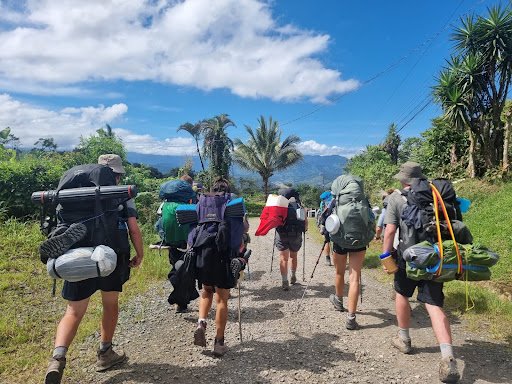
During my gap semester, I had the opportunity to participate in a program with Raleigh International in Costa Rica. I was pleasantly surprised to find out that there were 87 members in the program. Although initially shy, my previous experiences helped me come out of my shell. I made lots of new friends and had a great time socializing with everyone.
As I was only there for seven weeks, I only participated in two phases: trek and community. During the community phase, we built a classroom entirely from scratch, which was a lot of fun. The second phase was the trek, which was quite challenging but also incredibly rewarding. We hiked for 250 kilometers and faced numerous obstacles along the way. However, these challenges brought our group closer together and made us stronger. Finally, arriving at the beach after such a long hike was an indescribably rewarding experience, and doing it with my friends made it even better.
Trekking in Costa Rica
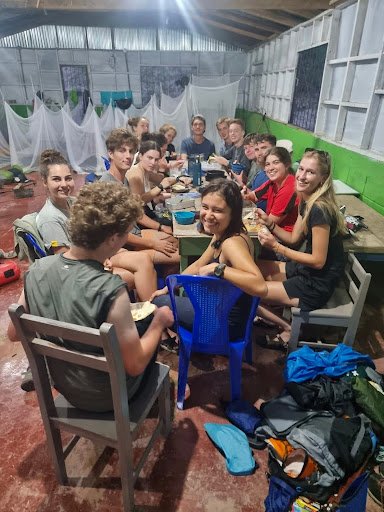
Mealtime and sleeping quarters while trekking in Costa Rica
Gap Year Planning, Where to Start
The gap year is still a relatively new phenomenon for most Americans, so it’s not surprising that many families find themselves navigating unfamiliar territory as they approach the gap year planning process. First off, it is important that the student be an active and willing partner in the decision to pursue a gap year. Like so many growth experiences, one gets out of a gap year what one is willing to put into it.
To guide the gap year planning process, I generally recommend that students come up with some goals for their gap year, ie. become more independent, improve language skills, gain professional experience through an internship or work experience. Gap year goals will help to give a clear vision of what the intentions are for a student’s gap year. Remember, a gap year is intended to be a year of growth and development, not a year of aimless wandering. Next they’ll want to determine how long the gap year last. Will it be a full year? 14 months? 1 semester? The choice is yours. It is recommended that you have a planned start / end date for your gap experience before it begins.
Once you have determined gap year goals and length of experience you’ll need to come up with a budget. How much money do you have to work with? Good gap years do not need to cost $30,000+ (though some do). It is possible to have a transformative gap experience on a budget. (See Paying for a Gap Year). Be realistic with your budget. If you are a Sophomore or Junior, you might consider getting a summer job to help pay for it. You might also consider imbedding some work experience into your gap experience to help fund travel later during your gap year.
Once you have determined your budget for your gap experience, you can begin looking at programs that match your gap year goals and budget. Keep in mind that your gap year does not have to consist of one single experience. Many gappers participate in 2-3+ experiences during their gap year. I generally recommend that students begin with a more highly structured and supported experience and transition into more independent ones. There are thousands of gap year opportunities, both experiences that are specifically tailored and marketed as gap year experiences, as well as experiences that might be suitable for a gap year, yet do not specifically market themselves as such.
When evaluating gap year programs you can consider online reviews, but don’t hesitate to reach out to the organization directly to ask questions or even request to speak with a former participant or parent. Glossy photos and marketable buzz words do not make up for quality programs and demonstrated experience. If you have any medical conditions or severe allergies, inquire if they are able to, or how they might support someone with those needs. Ensure you are clear about what type / level of support is offered and that it matches your needs. Will there be someone checking in with you each day, weekly, monthly? What happens if you need to visit a doctor? Will someone be available to assist you, or are you capable and comfortable navigating this on your own? Be honest with yourself about your capabilities and areas where you need more support. Clear, honest communication and appropriate expectations are critical for a positive gap experience.
You might be wondering where college fits into the gap year planning process. It is different for everyone. Generally I recommend that students apply to college their senior year, while they have the support of their college counselors. After receiving offers of admission and determining where you’ll attend college, you should contact your admissions office to request a deferral. You’ll want to demonstrate that you have a solid plan and intend to use your gap year to become an even more qualified candidate. You might not have your gap year plans firmed up by this point, but you should at least be able to articulate why you want to take a gap year and some goals you have for your time. More and more colleges and universities are embracing and even encouraging students to take advantage of the gap year, so you should not let fear of losing your spot deter you from taking a gap year. Be aware of how a deferral might affect any scholarships or financial aid you may have been awarded, as well as any restrictions on earning college credit during your gap year.
For students who may need to apply to college during their gap year, you’ll want to ensure that you dedicate sufficient time during your gap year to completing those applications and admissions essays. Whether it be having a summer experience and then returning home to work on applying to colleges, or having college applications prepared before you depart for a fall gap experience, be sure to plan in advance.
Feeling overwhelmed with gap year planning or having difficulty finding the right fit? Students or parents might wish to schedule a no obligation exploratory conversation to answer questions or clarify what a gap year might entail.
Paying for a Gap Year
A well-planned gap year does not require you to spend thousands of dollars. Some of the most transformative gap years are also the most affordable. You may find that a gap year actually helps to save you money.
Whether you are a student or parent of a student interested in a gap year you are probably trying to figure out how (and why) you should pay for a gap year when you’ve got college tuition to worry about. This is a totally reasonable concern. However, a well-planned gap year does not require you to spend thousands of dollars. Some of the most transformative gap years are also the most affordable.
You may find that a gap year actually helps to save you money. According to data from the nonprofit Complete College America, only 20 percent of students complete a bachelor’s degree in four years. Only 57 percent of students who enroll in college will graduate in six years. That means there is a very high likelihood, that students entering college next year, right out of high school, will take longer than 4 years to graduate, accruing more debt as a result. In contrast, research has found that students who take a gap year are more likely to graduate in 4 years or less. A gap year allows students to explore possible career or major options, work a minimum wage job (gaining critical perspective on the opportunity value of a college degree), travel, and often take a much needed break from academia for their personal mental health. The result is a more mature, focused, and generally well-prepared student entering college.
Work Work Work
Self-funded gap year travel is much more affordable than most peer-based travel programs. I paid for 2 months in Australia, New Zealand & Fiji by babysitting and working at a frozen yogurt shop for a year. Working to pay for your own travel makes the experience more meaningful, because you know how hard you worked to get there. Funding your own travel experiences also means you will likely be more frugal and make better choices when spending money during your travels.
Working during the summers throughout high school could allow you to save up enough to spend your entire gap year abroad. Many students spend part of their gap year working while living at home to fund travels during the second half of their gap year. There are also opportunities to work while you travel during your gap year through programs such as Work Away or Woofing.
Consider the Cost
Destination matters when paying for a gap year - Southeast Asia, Central, or South America are less expensive than Australia, New Zealand, or Europe. Staying in one place is cheaper than hopping from one destination to the next. You don’t have to leave the United States (or your home country) for an epic gap year travel experience! The cost of your airfare will take up a big portion of your gap year budget. Instead of planning a round the world trip, spend several months getting to know the hidden gems and off the beaten track places of a country or continent. A few months of volunteering followed by several weeks of independent travel is a great way to immerse yourself in local culture without spending a ton of money. Use local transport options and eat local food (or cook your own food) for a more authentic experience. Staying in hostel dorms, with family, friends, or camping will cut your expenses a considerable amount.
Start Planning Early
Fully funded gap year opportunities often have earlier application deadlines, so start researching opportunities during your freshmen - junior years so that you can anticipate application deadlines. Do your research and find a scholarship or program that really suits you and your gap year goals. Work hard on your application, and ask someone to read over your essay if one is required. Be sure to allow enough time for any references or recommendations to craft a thoughtful letter of recommendation for you.
Some universities, such as University of North Carolina Chapel Hill, Florida State University, and Tufts University offer gap year programs with merit and/or need-based scholarships to fund some admitted students’ gap year experiences. If you are considering applying to a school that offers a gap year program, get in touch with the school’s Office of Admissions to find out what you need to do to be considered for their gap year program.
Be Proactive
In order to increase accessibility, more and more gap year programs are offering financial assistance and need-based scholarships. Not all programs spend money to advertise their financial aid though. If the program you are interested in does not specifically advertise financial aid, reach out to ask if they do offer scholarships or financial aid. If you are planning an independent gap year, but need some help with planning details, many Gap Year Consultants (myself included) offer need-based assistance or scholarships for their advising services.
More students are interested in having an internship experience during their gap year. If you have a particular career or job that interests you because of someone you know that does it, ask them if they might be able to help you secure an internship during part of your gap year. Be sure and make it clear you’d like to gain real experience and an understanding of what a career in the field is like. You shouldn’t waste a semester in an unpaid internship if all you will be doing is making coffee (unless you are interning at a coffee shop).
Don’t Give Up
If you don’t get that scholarship or internship you had been hoping for, don’t give up! Failing and learning to bounce back is an important part of growing up. I have found that when things don’t go as planned I am usually pleasantly surprised with the result, and I’ve learned to become more adaptable and resilient because of my failures.
Maybe you’re reading this because you didn’t get in to any of the colleges to which you applied and you find yourself facing a gap year by default. You didn’t plan for one and haven’t saved for one. All is not lost! Many organized gap year programs have begun partnering with community colleges or universities to offer college credit options for gap experiences. The catch is, if you are admitted to a college and choose to defer your admission for a gap year, most schools stipulate that you cannot earn college credit during your gap year. Therefore, you can only take advantage of the opportunity to earn college credit during your gap year if you have not deferred admission for the following year. Getting practical or travel experience while earning a semester of college credit is a pretty good silver lining! Some programs that offer college credit can also be paid for using a 529 college savings plan.
If you are planning to re-apply to colleges during your gap year, it is important that you plan ahead and allow enough time to dedicate to applications / interviews. Work on applications over the summer and have them all ready to submit if you will be traveling during the fall semester. Use your gap year to learn more about yourself, your interests, skills, and goals for the future. If you approach your gap year with the right intention, it won’t be a waste of time or money, but a wise investment in your future.
Scholarship Resources: