
Josie's Semester in Central America
Guest post by gapper Josie, describing her semester in Central America during the fall of 2021
During the fall semester of my gap year I spent two months in Costa Rica and Guatemala. Both countries are equally stunning. Costa Rica was filled with beautiful beaches and incredible wildlife whereas Guatemala held rich culture and gorgeous volcanoes. I was able to learn a lot in both countries. In Costa Rica I was more focused on nature, environmental issues, and wildlife (specifically sea turtles). In Guatemala I took time to learn more about Mayan culture, the history of the country, and spent more time working on my Spanish skills.
Costa Rica
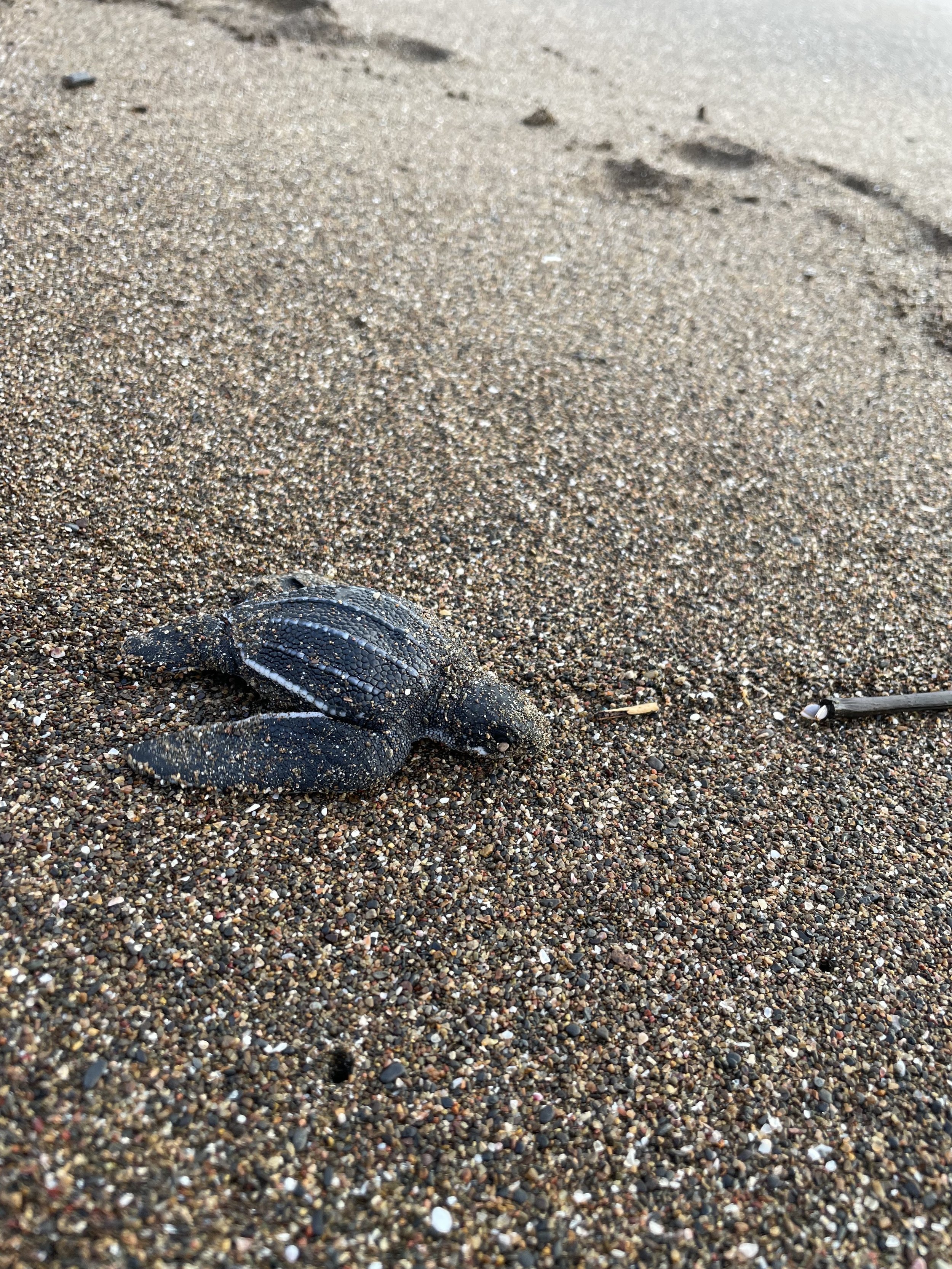
I spent six weeks in Costa Rica moving around the Pacific side of the country. I spent time in Santa Teresa, Montezuma, Samara, and Monteverde. I spent most of my time doing volunteer work (cleaning up microplastics on the beach, working in a recycling center, and working at sea turtle hatcheries). Plastic is a huge issue on the beaches in Costa Rica even though the country itself has moved to start banning all single use plastics. Trash is constantly washing up on the beaches and whenever I participated in beach cleans it was easy to fill up a large bag with plastic within only about fifteen minutes. For me this put into perspective the harsh reality of the materialistic lives that many people, including myself live. Now when I find myself in a grocery store or gas station, I cringe at the hundreds of plastic bottles and the plastic packaging lining the shelves knowing that they could very likely end up washing up in a beautiful place such as Costa Rica. Other than learning about the effects of plastics on the environment and cleaning them up off beaches, I also spent time taking Spanish classes, exploring the towns I was in, and taking in the beautiful landscapes laid out in front of me. Some of my all time favorite experiences in Costa Rica were getting to work up close with sea turtles. I spent time in two different turtle sanctuaries where I was able to help release baby sea turtles into the ocean and watch over the hatcheries. I even got to swim with an adult sea turtle! That is definitely a memory that I will cherish for the rest of my life.
Guatemala

I only spent about two and a half weeks in Guatemala but during that time I was able to have some of the most amazing experiences. In Guatemala I visited Antigua, Lake Atitlan, Flores, and Semuc Champey. Guatemala is the land of volcanoes. There are 37 volcanoes in Guatemala and I even got to hike up one. In my first few days I hiked Acatenango and after a seven hour uphill trek I was met with stunning views of Volcan de Fuego. When I say that this was one of the most amazing things I’ve ever seen I’m not exaggerating even a little bit. It was freezing and windy at our camp on Acatenango and even though the weather sounds miserable, there’s no way to be unhappy when you are sitting on top of one volcano while watching another one erupt every 15-20 minutes.
Throughout the rest of my time in Guatemala I was immersed in beautiful landscapes and an interesting culture. Guatemala holds some of my favorite memories such as swimming in Lake Atitlan at sunset with my friends, watching the sunrise over the volcanoes and Antigua from 12,000 feet up and meeting new people from all around the world. Near the end of my time in Guatemala, I spent five days solo in Antigua where I spent everyday wandering through the ruins and the city. I easily spent five or six hours a day just roaming around the city meeting new people, trying local restaurants and practicing my conversational Spanish skills with the locals.
Both Costa Rica and Guatemala were breathtaking countries and I’m extremely grateful for the time I was able to spend there. I not only learned about the environment, culture, and history but also about myself. One of my biggest goals in taking a gap year was to push myself out of my comfort zone and I would say that I definitely achieved that while I was in Central America. I found myself trying new things and encountering things that normally would have scared me on a daily basis such as snorkeling next to sharks, finding a Boa Constrictor in my room, climbing volcanoes, and much more. I pushed myself to take in every experience no matter how much it freaked me out because that’s the only way I was ever going to learn to find comfort in the uncomfortable experiences. Of course everyday wasn’t perfect, I had days where everything seemed to go wrong or where my mental health took a toll on me but by the end of two months I found myself almost embracing these discomforts. Not everything can be perfect, even when you feel as though you’ve woken up in paradise. Those discomforts and struggles were part of the journey and can’t be ignored when reflecting on my experiences because some of those experiences were just as important as the good ones. I believe that going into my trip to Central America, I had this idea that it could fix some things in my life or that it could fill in the gaps of what I felt as though was missing from my life. In some ways it did offer me relief, I found the importance of being grateful for every day and never taking anything for granted and I felt as though I was truly living everyday. On the other hand, I realized that even the most beautiful places and amazing experiences can’t solve every problem. I will always be grateful for my time in Costa Rica and Guatemala because as my first international travel experience, I feel as though I was able to learn a lot about myself while simultaneously learning about the world.

Antigua, Guatemala

Volcan de Fuego
Josie was the recipient of the 2021 Free to Roam Adventures Counseling Scholarship. Her budget for her two months in Central America was under $6,000. She was able to fund her travels through part-time work during and after high school. The deadline to apply for the 2022 Counseling Scholarship is April 2022.
Gap Year 101
What is a gap year? -- IT'S A GROWTH YEAR NOT A LOAF YEAR!
- A gap year is a period of time, usually between high school and college, when students take a break from formal classroom-based education to deepen their personal, practical, and professional awareness.
- Gap years are not a break from learning, instead gap years are intended to help students develop practical skills and gain greater clarity of personal values and goals for the future.
The best gap years are rooted in experiential education for a minimum of 2 months.

A well-planned gap year typically includes 2-4 of these components:
- Service/Volunteering
- Career Exploration
- Paid Work
- Travel/Adventure/Fun
Sample Gap Year Plan:
🍁 Fall Structured program with a group and instructors
🏡 Return home for holidays
❄️ Winter/Spring Explore possible major and/or career options via independent volunteer placement, internship, or work abroad
🌞 Summer Paid Work, Travel, Preparations for College
During your gap year you can expect to be challenged

- Different Cultural Traditions
- Foreign Languages
- Homesickness
- Stereotypes
- Physical & Mental Health
- Time & Money Management
But also rewarded...
- Broaden your perspective
- Improve your communication skills
- Develop greater maturity and resilience
- Develop greater clarity of academic major and/or career focus
- Gap year alumni demonstrate higher levels of engagement on campus and in their communities
- Research shows that students who took a gap year have higher GPAs compared to those who did not take a gap year
- Students who took a gap year are more likely to graduate in 4 years or less compared to national average of 6 years
How much does a gap year cost?
Cost of a gap year depends on a variety of factors (location, level of support, type of experience, etc.)
Most organized programs cost between $2,500 - $10,000+ per semester
Gap Year Advisors are another expense that can help you save money by offering guidance planning an independent experience. Gap Year Advisors recommend vetted programs, volunteer and internship options not always visible at fairs or in online searches.
A Service Year is a great low-cost option for a gap year experience and may make you eligible for a college scholarship upon completion. Many service year programs require a 10-12 month commitment. They typically cover all expenses and offer a modest living stipend. Examples: (AmeriCorps NCCC or City Year)
Timeline for Planning a Gap Year
- Apply to college in the fall of your senior year
- Decide if a gap year is right for you
- Research gap year opportunities (Attend Gap Year Fairs, Speak with a Gap Year Advisor)
- Apply to gap year programs late fall-spring of your senior year
- After receiving your offer of admission, request a deferral to the college you will attend when your gap year ends
Things to Consider
What is your motivation for taking a gap year?
What are you interested in exploring during your gap time?
What is your budget?
Do you want to travel? If so, where?
What are you comfortable with? (Solo or Peer-based travel? Rugged experiences? Rural homestays?)
Still have questions? Don't hesitate to get in touch!

Weekend in Switzerland
I’m not sure why I waited so long to return to Switzerland, but my weekend visit this fall is certainly not going to be my last! People are always asking me which country is my favorite. I tend to have different categories - favorite place for food, outdoor adventure, beach, nightlife, etc. New Zealand, Chile, and the U.S. are among my favorites for outdoor exploration. Switzerland just gave them all a run for their money though - The Jungfrau region is by far the cleanest place I have ever visited (I saw one piece of liter the entire time) plus it is super accessible with public transportation.
I traveled by train from Paris to Interlaken and then from Interlaken to Florence. If you are studying abroad or planning to travel to either place, Interlaken is easy to get to while still being scenic enough to give you a break from the hustle and pollution of the cities. I stayed three nights at an Airbnb in Interlaken. Staying at an Airbnb is one great way to save money, plus I got some great tips from my host. There was a mini-fridge in the room, so I was able to buy groceries for breakfast, snacks, and store left overs. My host provided me with a discount card for travel within the region as well. You will need to take regional trains for day trips into the mountains.
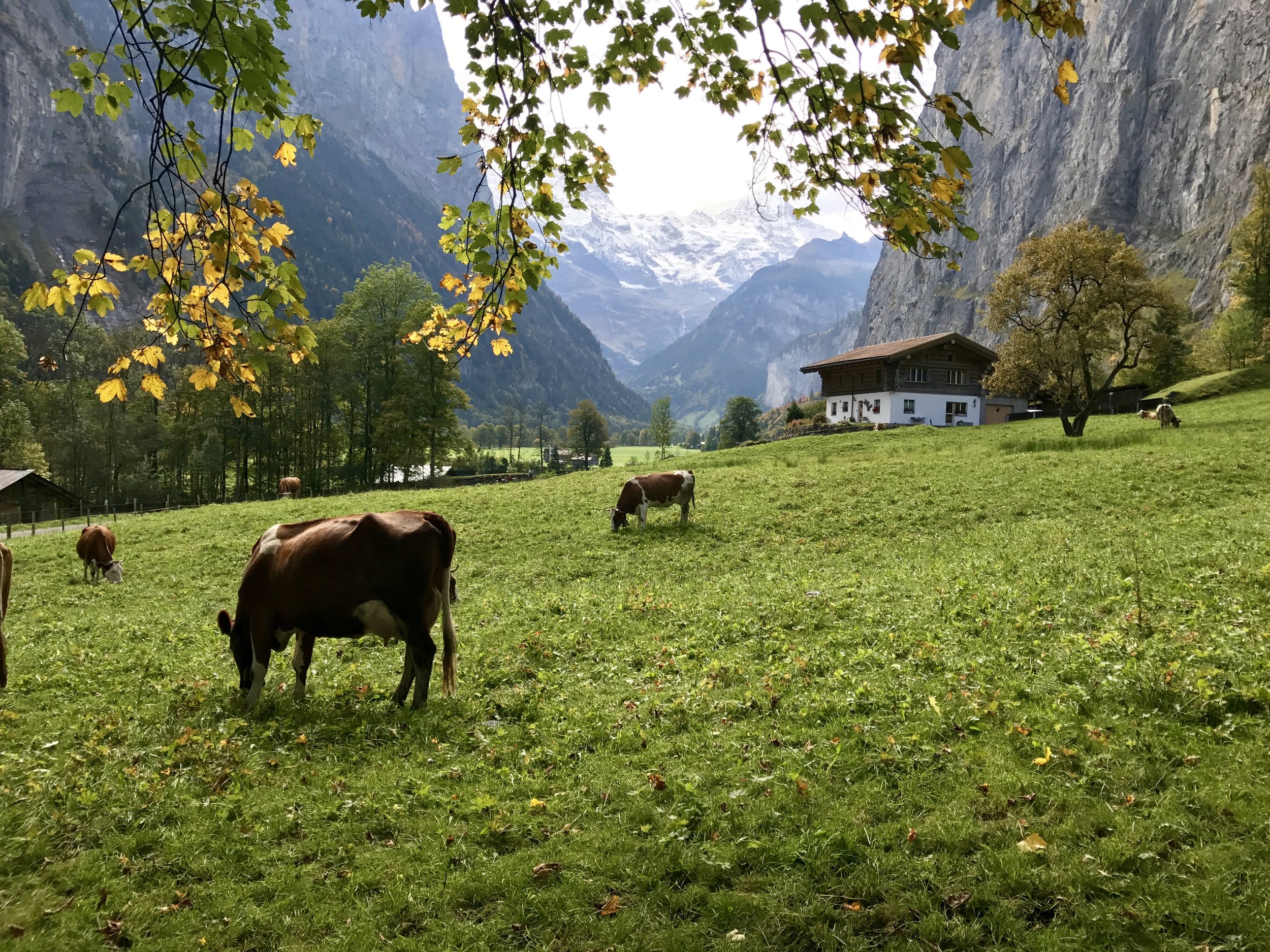
Interlaken was a great home base for exploring the Jungfrau region. You can easily catch a train to surrounding mountain towns. My first full day I took the train to Lauterbrunnen (recommended by my Airbnb host). It was only a 20 minute train ride and return trip cost 11.40 CHF (including a discount with my Eurail pass). You can purchase a ticket at the ticket office in advance or on the train. Be sure to carry some cash with you, if you plan to purchase tickets on board the train or bus. I didn’t have much of a plan, so I allowed myself to become entranced with the beauty of the valley and kept walking what seemed like the entire length of the valley. There are waterfalls along the mountainside and farms selling fresh cheese in vending machines. It was a mostly flat walk from the train station through the Lauterbrunnen Valley to Stechelberg (you can also take a bus).
At Stechelberg I hopped on a cable car up to Murren (8.60 CHF one way). I explored the village, took in the dramatic views from above, grabbed a picnic lunch at a small grocery store, and then decided to walk back down into the valley. The walk from Murren to Gimmelwald is stunning and on a paved path that only takes 30 minutes. If you are fit and enjoy walking, I recommend walking all the way down to the valley. The walk from Gimmelwald to Stechelberg took about 1 1/2 hr (all down hill) on well maintained and marked hiking trails. In Stechelberg I caught a bus (5.40 CHF) back to the Lauterbrunnen train station. This whole day trip took me around 7 hours, though I stoped to take LOTS of photos.

path from Mürren to Gimmelwald
My second full day I took the train from Interlaken to Grindelwald. Grindelwald is about 30 minutes from Interlaken and a roundtrip train ticket cost 18 CHF (with a Eurail pass holder discount). From Grindelwald I decided to walk up to Bort, a steep climb of about one hour on a paved path with stunning views of the town and surrounding snowcapped mountains. You also have the option of taking a cable car to Bort, or further up the mountain to First. At First you can also rent mountain carts to ride down to Bort. This whole region is very touristed, but many tourists don't go far from the cable cars, so you can still enjoy some serene wilderness if you choose to walk rather than ride up and down in the cable car. There are signs at regular intervals and the towns are so small it is really difficult to get lost.

View of Grindelwald from Bort
After having a picnic lunch in Bort, rather than following the paved path up to First, I veered off to a wilderness trail and meandered up the mountain a bit further before returning to Grindelwald via different wilderness trails. I didn't really have much of a plan, just went where the views guided me and I was not disappointed. Happy trails!
Staying Fit While Traveling - Europe
Having spent most of the last four years traveling, I learned that maintaining a fitness regiment while on the road requires commitment and planning. I am a runner, which also happens to be a great way to exercise while traveling, because you don't need any equipment, other than running shoes. Running also allows you the chance to move about a city the way locals would. Rather than just hitting the tourist destinations, you get to see what everyday life is like in the place you're visiting. I explored some pretty amazing parks, coastlines, and palaces on my runs in Europe. If you are planning a trip to any of the following cities, I hope this helps you maintain your routine and enjoy some sights that are not typically part of the tourist circuit.
We started our trip in London where our schedule was pretty packed. I was able to get to Hyde Park once on an unusually sunny Sunday. If you are staying in or near central London, Hyde Park is easily accessible via public transport, or you can run to the park. Even if you are not into running, Hyde Park is worth a visit. Grab some friends and a picnic or take a paddle boat out on the Serpentine. Regents Park is another great place for a run and you get to experience the lovely English Gardens. London weather might not always be conducive for outdoor activities, so when it is you better take full advantage!

English Gardens at Regents Park in London
Madrid has one of my favorite parks for running - El Retiro. I jogged the mile from our hostel near Plaza del Sol to the park and found myself right at home among many runners in a green leafy oasis. There is a worn path along the perimeter of the park where most of the runners were. I did 2 loops and estimated it was about 3 miles. There are plenty of grassy areas for stretching or cross-training exercises. There is even a lake in the park where you can rent row boats for an upper body workout.
It's no surprise that Barcelona is great for outdoor activities in September. From La Rambla head towards Barceloneta beach and then follow the boardwalk to the North as far as your legs will carry you. The further you go from La Rambla, the less crowded it gets and the more runners you will likely encounter. I suggest going in the early morning or early evening to avoid some of the beach crowds and the heat. There is also an outdoor workout along the boardwalk area with basic equipment where you can do pull ups, dips, sit ups, etc.
Paris is a sprawling city with lots of beautiful architecture, art, and some elegant historical parks. Our hostel was only 1/2 mile from the beautiful 19th-century Parc des Buttes-Chaumont. This is a great place to explore on a run, go for a walk, or take a picnic. There is a lake with a waterfall and impressive stone bridges, and even a hilltop temple modeled after the ancient Roman Temple of Sybil. You'll get a great hill workout here too. If you are staying in or near the 10th arrondisment, you should definitely visit this park.

While Paris has incredible cuisine, Florence is my personal favorite European city for food - gelato, pizza, meatballs, cannoli - everything tastes amazing in Florence! The secret is out because, Florence seems to be more and more crowded each time I visit. It would be difficult to run in or around the city center due to the crowds unless you wake up super early. I discovered a park just west of the city center - Le Cascine, perfect for escaping the throngs of tourists. From the historic center head towards the river and without crossing, follow it west for about 1.2 miles. As you approach the park the sidewalk ends and you need to cross a pedestrian bridge to your right to get to the park. There were mostly locals jogging, biking, and roller blading so it feels a world away from the crowds around the Duomo. There are several options to make a loop of the park on paved or dirt paths. One loop is about 3 miles. There are plenty of open grassy spaces in this park as well.
Vienna wins the award for most unique and palatial running space. You can run in the Schönbrunn Palace Gardens. You do not need a ticket to enter the palace to enter the gardens (which I found more impressive than the palace interior). Enter the gardens from the front gate of the Palace, continuing around to the right side and behind the palace, or you can enter the gardens directly from from the Eastern entrance. Part of The Sound of Music was filmed here, so I suggest downloading the soundtrack to make your run a bit more whimsical. There are ornate shrubs and flowers, Roman statues and marble fountains. There is a hill directly opposite the palace from which you can get a nice view of the city. If you get to the top of the hill, rather than returning back down the middle path, I suggest veering towards the Western entrance and finding some of the forest trails to meander your way back down the hill. Be sure to check the Park hours which change seasonally before heading out for your run.

Schönbrunn Palace Gardens Vienna, Austria
There was a marathon in Budapest during our visit in mid October. I ran in Széchenyi-sziget Park where the race was finishing. While the park was rather small for a long run, my jog from our hostel in the Jewish Quarter to the park was quite nice. It probably helped that some of the traffic and smog was diminished due to car traffic being limited for the marathon. After your run you shouldn't miss soaking in the thermal baths located in the park or at Gellért Baths across the river in Buda.
Berlin is one of the easiest cities in Europe for running, walking, or biking. Our hostel was located in Mitte which is dotted with quaint parks, but nothing large enough for a long distance run. I ended up running along the sidewalks through Mitte towards the Spree, where I joined a paved pedestrian path that follows the river towards the Central Train Station. I followed this path until just before the train station (opposite side of the Spree), when I climbed the stairs near the Bundestag and headed towards Tiergarten Park. Tiergarten is an expansive shady park right in the middle of central Berlin. From Mitte to roughly the middle of Tiergarten and back was about 6 miles.
Brussels was another favorite running destination for me, especially on the weekend when the city is less crowded and many shops are closed. I ran down Koningsstraat to Brussels Park, passed through the park and continued down Wetstraat towards Cinquantenaire Park. Cinquantenaire is a large park with a path around the 1.4 mile perimeter. I never tried this route on a weekday, but I suspect, given the proximity to EU Headquarters, there may be a prohibitive amount of pedestrian traffic during the week. Definitely worth a visit during the weekend.

Cinquantenaire Park, Brussels
Amsterdam is another pedestrian friendly city, as long as you respect the bike lanes! The Dutch enjoy being outside, no matter the weather, and they are also one of the more fitness oriented cultures in Europe. During my first visit to Amsterdam I stayed right by Vondelpark which was a great place for running close to the Rijksmusem and Van Gogh Museums. The loop around the park is about 2 miles. Last fall we stayed at the new Generator Hostel which backs up to Oosterpark which is smaller but easily accessible for a shorter run or cross-training workout.

Vondelpark in early November
I use the app Strava to map my runs and find other common running routes in new places I visit. Its free and works everywhere, as long as you have a good international data plan.